If you look after other people’s dogs or cats for money in England, you almost certainly need a licence from your local council. The same rules cover pet shops, dog breeders, riding schools that hire out horses, and businesses that keep or train animals for exhibition. This guide explains which activities need a licence, what inspectors check for boarding kennels, home boarding and day care, how star ratings and licence length work, and what that means when you buy kennels, cattery pens and other equipment.
The rules come from the Animal Welfare (Licensing of Activities Involving Animals) (England) Regulations 2018. Defra publishes detailed statutory guidance for local authorities, which councils must have regard to. It is written for inspectors, so it is the best way to see your premises the way they will.
Which activities need a licence
Schedule 1 of the regulations lists five licensable activities. Boarding is one activity with four types, and a business doing more than one type, such as kennels plus day care, needs each one covered on its licence.
| Licensable activity (Schedule 1) | What it covers | Typical businesses |
|---|---|---|
| Selling animals as pets | Selling animals as pets in the course of a business, including keeping them for later sale | Pet shops, aquatic retailers, reptile shops |
| Providing or arranging boarding for cats or dogs | Boarding for cats, boarding in kennels for dogs, home boarding for dogs, day care for dogs | Catteries, boarding kennels, home boarders, dog day care centres |
| Hiring out horses | Hiring out horses for riding or riding instruction | Riding schools, trekking centres |
| Breeding dogs | Breeding three or more litters in any 12 months, or breeding dogs and advertising a business of selling dogs | Dog breeders |
| Keeping or training animals for exhibition | Keeping or training animals in a business for educational or entertainment purposes, to a live audience or on film | Animal experiences, film and event animals |
Dog grooming, dog walking and pet sitting in the owner’s home are not on the list, so they do not need an animal activity licence in England. They still need the right insurance, which is covered in our guide to pet business insurance.
What inspectors look for in dog boarding
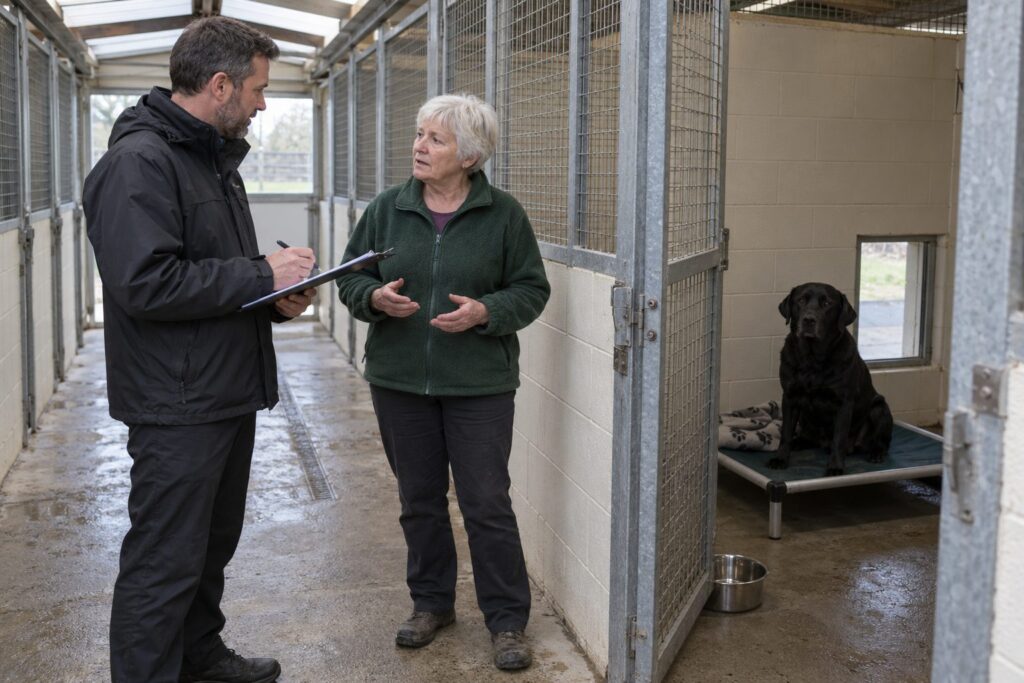
Each activity has its own statutory guidance with minimum standards and optional higher standards. For dog kennel boarding, the guidance says all kennel boarding needs a licence if it is run as a commercial business. Some of the points that most affect what you build or buy:
- Sleeping area size. Each kennel’s sleeping area must let the dog sit and stand at full height, lie fully stretched out, wag its tail, walk and turn around without touching another dog or the walls. The floor must be at least twice the area the dog needs to lie flat, and kennels built after the regulations came in must have at least 1.9 square metres of sleeping area. That applies to new builds and extensions, not to rebuilding on an existing footprint.
- Materials and upkeep. Buildings must be robust, safe and in good repair, with no sharp edges or projections. Timber must be good quality, sealed and treated, and no standing water from cleaning or urine is acceptable.
- Numbering and records. Every kennel unit must be numbered, with information about each dog available to staff and inspectors.
- Staff competence. Staff caring for the dogs must hold a formal qualification, such as an Ofqual-regulated Level 2 qualification suited to their role, or show relevant and sufficient knowledge and experience. Anyone working towards a regulated qualification must make progress within 12 months and finish within 2 years.
For kennel blocks, galvanised run panels and drainage, the specification you give a kennel manufacturer should start from these conditions. Ask suppliers to confirm in writing which standard a design is built to, and whether it meets the higher standards if you are aiming for a 4 or 5 star rating. Our kennel panels and runs listings include several manufacturers that state their kennels are designed around the 2018 regulations.
Home boarding and dog day care
Home boarding has its own guidance. The licence must state the maximum number of dogs that can be boarded at the premises, and undeclared numbers are a breach, especially if staffing has not increased to match. Outdoor areas must not be used by more than one dog at a time unless the dogs are from the same household or the owner has given written consent.
The dog day care guidance is clear that dogs may not stay overnight and the premises must be a fixed location. On staffing, it says each member of staff should have 10 dogs or fewer to care for, and each dog must have 6 square metres of space available within the premises, which can include inside and outside space. Those two numbers drive the size of building, the outdoor area and the team you need, so work them out before you sign a lease. Equipment for play areas, rest areas and secure outdoor space is listed under dog day care equipment.
Star ratings and how long a licence lasts
Every licence carries a star rating from 1 to 5, based on the business’s compliance history and the inspection. Businesses that meet all of the required higher standards and at least half of the optional higher standards qualify for 4 or 5 stars and a longer licence. The licensing process guidance sets out the matrix below.
| Risk | Inspection result | Stars | Licence length | Unannounced visit |
|---|---|---|---|---|
| Low | Minor failings | 1 | 1 year | At least 1 within 12 months |
| Low | Minimum standards | 3 | 2 years | At least 1 within 24 months |
| Low | Higher standards | 5 | 3 years | At least 1 within 36 months |
| Higher | Minor failings | 1 | 1 year | At least 1 within 12 months |
| Higher | Minimum standards | 2 | 1 year | At least 1 within 12 months |
| Higher | Higher standards | 4 | 2 years | At least 1 within 24 months |
The rating must be shown on the licence, which the business should display, and councils should publish lists of licensed businesses and ratings on their websites. A business can ask for a reinspection to improve its rating, but there is a fee for each visit at full cost recovery, and the council can refuse if the evidence is not there.
What a dog boarding licence costs
There is no national fee. Under regulation 13, councils can charge for considering an application, including inspections, for compliance checks on existing licence holders, and for enforcement against unlicensed operators. They must set fair and reasonable fees, so prices vary from one council to the next. Check your council’s licensing page for the current application and grant fee, and budget for vet inspection costs where the council uses a vet. A longer licence from a higher rating means fewer renewals, which lowers the cost over time.
Wales, Scotland and Northern Ireland
The 2018 regulations and the guidance above apply to England. Scotland has its own Animal Welfare (Licensing of Activities Involving Animals) (Scotland) Regulations 2021, and Wales and Northern Ireland run separate regimes. If you trade outside England, read your own nation’s rules and ask your council before you build.
A practical checklist before you apply
- Read the statutory guidance for each activity you plan to run, not just the general conditions.
- Decide your maximum numbers of dogs or cats, then size buildings, outdoor space and staffing to match.
- Brief your kennel and cattery suppliers with the relevant size and material standards, and keep their written confirmation for your inspector.
- Plan cleaning and disinfection routines and stock suitable products. See kennel cleaning and disinfectant suppliers.
- Line up staff training towards a regulated qualification. Course providers are listed under grooming schools and courses, and some cover animal care qualifications too.
- If you want help preparing, browse licensing and compliance consultants, and set up booking software that records vaccinations and consent, listed under booking and business software.
Planning a cattery? Our guide to starting a cattery sets out the minimum pen and run sizes in full.
Sources
- Schedule 1, Animal Welfare (Licensing of Activities Involving Animals) (England) Regulations 2018
- Dog kennel boarding licensing: statutory guidance for local authorities (Defra)
- Home boarding for dogs licensing: statutory guidance (Defra)
- Dog day care licensing: statutory guidance (Defra)
- Animal activity licensing process: statutory guidance (Defra)
- Animal Welfare (Licensing of Activities Involving Animals) (Scotland) Regulations 2021